HG 486/2026: 759 million lei for new factories of at least €10 million, until 25 November
The Ministry of Finance is accepting applications in the Big Project 486 platform until 25 November 2026, 17:00. Call window 1 has 759 million lei for investments of at least 50 million lei in products with a trade deficit, as a grant or tax credit.
Todos & Company editorial team · EU funding consultancy since 2006
 Programme sheet · Call window open State aid scheme for products with a trade deficit in the manufacturing industry (HG no. 486/2026) Deadline: 25 November 2026
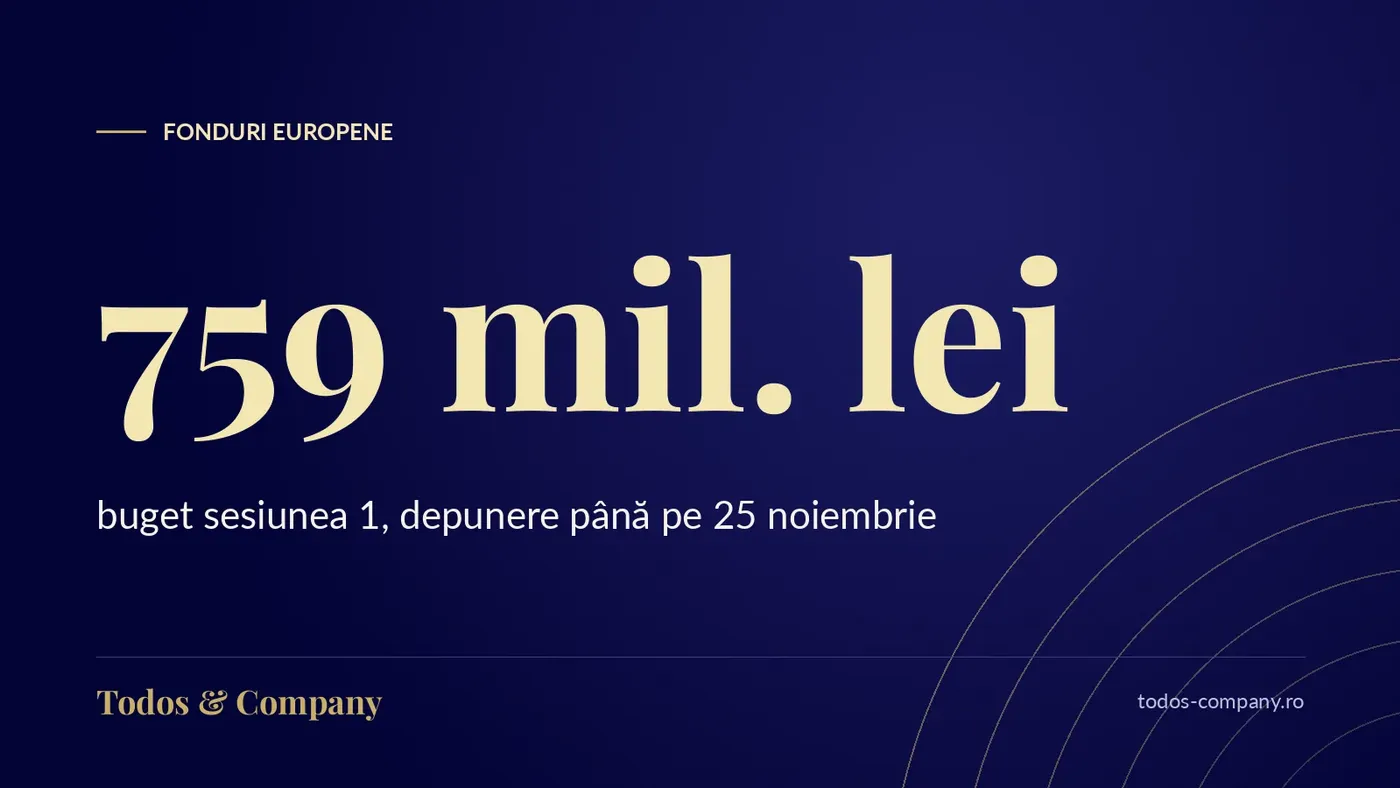
The first call window of the state aid scheme established by HG no. 486/2026 has been open since 15 October 2026: the Ministry of Finance accepts applications for a funding agreement exclusively online, through the Big Project 486 application, until 25 November 2026, 17:00. The budget for the window is 759 million lei, and projects must be initial investments of at least 50 million lei (approximately 10 million euro) in manufacturing products for which Romania imports more than it exports. The aid is granted either as a grant or as a tax credit, at the company's choice.
In brief
- Programme: State aid scheme to stimulate investment in the manufacture of products with a trade deficit in the manufacturing industry (HG no. 486/2026, published in Monitorul Oficial no. 509 of 22 June 2026; applicant's guide approved by OMF no. 923/2026, Monitorul Oficial no. 624 of 29 July 2026).
- Authority: Ministry of Finance.
- Beneficiaries: SMEs and large enterprises, newly established or already operating, with projects covering no more than two CAEN codes from Annex 1 to the decision, relating to the same technological flow.
- Total budget: 5.313 billion lei (around 1.05 billion euro) for 2026–2032, on average 759 million lei per year; call window 1 has 759 million lei; up to 200 enterprises are estimated to benefit.
- Value per project / intensity: eligible costs of at least 50 million lei; the maximum intensity is set by county in Annex 3 to the decision; own contribution of at least 25%.
- Submission period: 15 October – 25 November 2026, 17:00, online, in the Big Project 486 application.
- Status: call open (call window 1).
Who can apply?
The scheme is aimed at manufacturing companies of any size. Annex 1 to the decision contains 224 CAEN codes, from the food and textile industries to chemicals, pharmaceuticals, metallurgy, electrical equipment and motor vehicles. A project may cover no more than two CAEN codes from the list, relating to the same technological flow.
The conditions differ depending on the age of the company:
- Operating enterprises must have had a return on turnover above zero in at least one of the last three financial years and positive equity in the last closed financial year.
- Newly established enterprises (established in the year the application is submitted or with no more than 3 years of activity) must have a subscribed and paid-up share capital of at least 100,000 lei. The associates or shareholders may not hold, and may not have held in the last 2 years, at least 50% of the shares or equity interests of another company with the same activity.
What matters most is the product: the project must lead to the manufacture of goods listed in Annex 2, which lists over 200 products with a negative trade balance, for example medicines, integrated circuits, mobile phones or lithium batteries. Products that are not on the list receive zero points at evaluation.
Which costs are eligible and how much does the company receive?
The tangible and intangible assets of an initial investment are eligible: new buildings, technological equipment and new intangible assets. Two ceilings limit the structure of the budget: construction may account for no more than 40% of eligible costs, and intangible assets for no more than 30%. The company must provide at least 25% of the eligible costs from its own or external sources, free of public aid.
The aid takes one of two forms, at the beneficiary's choice:
- grant (non-refundable funds), paid in 2027–2036 on the basis of payment claims with supporting documents; verification takes up to 60 working days, and payment is made within 15 working days of the date on which the payment claim is considered complete and the on-the-spot check has been carried out;
- tax credit, calculated over 7 years, with the possibility of a 2-year extension, no later than 31 December 2036.
The maximum intensity depends on the county in which the investment is made and is set in Annex 3 to the decision. For large projects, the aid may not exceed the maximum amount calculated using the formula in Regulation (EU) no. 651/2014, and cumulation with other aid is permitted only within the intensity limit set out in the annex.
How are projects evaluated and selected?
The call window is not "first come, first served". After it closes, the Ministry of Finance calculates a score for each application and publishes the list within 5 working days at most. Applications enter the review in descending order of score; in the event of a tie, priority goes to the project whose product has the larger trade deficit. Checking an application takes up to 60 working days from its entry into the review, a deadline that also applies to documents requested later.
The score combines two components: the trade deficit of the products in Annex 2 (if the company selects several products, the simple arithmetic mean of their scores is used) and the other criteria in the calculation methodology in Annex 5 to the decision, including the degree of automation of the investment.
What obligations remain after the agreement is signed?
- the investment must be started within 6 months of the agreement being issued, with expenditure of at least 3% of the total value of the investment;
- completion is deemed to occur on 31 December of the year in which all the assets were acquired, but no later than 31 December 2037;
- the investment must be maintained for at least 5 years after completion;
- during this period, the company must achieve a turnover of at least 80% of the estimates in the business plan and a return on turnover above 2.5%, and 70% of the project's turnover must come from the products with a trade deficit;
- part of the raw materials, between 15% and 35% depending on the score undertaken, must come from the European Economic Area.
What this means for your business
Our recommendation: the scheme is for large, well-prepared industrial projects, not for modest expansions. The threshold of 50 million lei in eligible costs and the 25% co-financing require a demonstrable financial capacity, which the evaluators will assess from the financial statements and the business plan.
If you have such a project, the order of work we recommend until 25 November is:
- check the CAEN code in Annex 1 and, above all, the final product in Annex 2; without a product from the list, the deficit score is zero and the project drops down the ranking;
- choose between the grant and the tax credit according to your cash flow: the grant brings in money during implementation, while the tax credit requires sufficient taxable profit in the following years;
- build the budget within the ceilings of 40% for construction and 30% for intangible assets, and keep proof of your own contribution;
- calculate realistically the indicators you will owe for 5 years: 80% of the estimated turnover and the 2.5% return are obligations, not optional targets;
- prepare in good time the documents with a short validity, such as the certificate of good standing and the land register extract.
A common pitfall is overestimating turnover to raise the score: the estimate becomes a maintenance obligation, and failing to meet it may lead to recovery of the aid. You can start with the eligibility check or with the dedicated page on the HG 486/2026 scheme on our site.
Frequently asked questions
Can small or newly established companies apply too?
Yes. The scheme is open to SMEs and large enterprises, including companies established in the year of submission or with no more than 3 years of activity. New companies need a paid-up share capital of at least 100,000 lei and associates who do not hold, and have not held in the last 2 years, at least 50% of other companies with the same activity. The threshold of 50 million lei in eligible costs applies to everyone, however, regardless of size.
What happens if the budget of 759 million lei is not enough for all applications?
Applications are reviewed in descending order of the score published after the call window closes, and in the event of a tie the larger trade deficit of the product counts. The scheme is multi-annual, with agreements issued until 2032 and a total budget of 5.313 billion lei, so projects that are not funded now can be submitted in later call windows, which the Ministry of Finance announces at least 20 working days in advance.
When must the investment start and finish?
Works must be started within 6 months at most of the funding agreement being issued, with expenditure of at least 3% of the total investment. Completion is deemed to occur on 31 December of the year in which all the assets were acquired, at the latest on 31 December 2037, and the investment must then be maintained for at least 5 years.
Can I combine this aid with other funds?
Cumulation with other state aid is permitted only if the total intensity does not exceed the limit in Annex 3 for the county concerned. The own contribution of at least 25% must be free of any public aid.
Official sources
- HG 486/2026 on stimulating investment in the manufacture of products with a trade deficit in the processing industry (Legislative Portal)
- OMF 923/2026 approving the applicant's guide drawn up under HG 486/2026 (Legislative Portal)
- Ministry of Finance – state aid announcements (call window 15 October – 25 November 2026, Big Project 486 application)
Information checked on 19 October 2026. Conditions may be changed by the managing authority — check the guide in force before you submit.