EU funds without co-financing and funding for PFAs: which programmes cover 100% in 2026
Only a few programmes cover 100% of eligible costs: solar with storage for public institutions (submission from 28 September 2026) and EIC Pathfinder. Agricultural PFAs (sole traders) can access DR-14 (85%) and DR-12 (80%/65%).
Todos & Company editorial team · EU funding consultancy since 2006
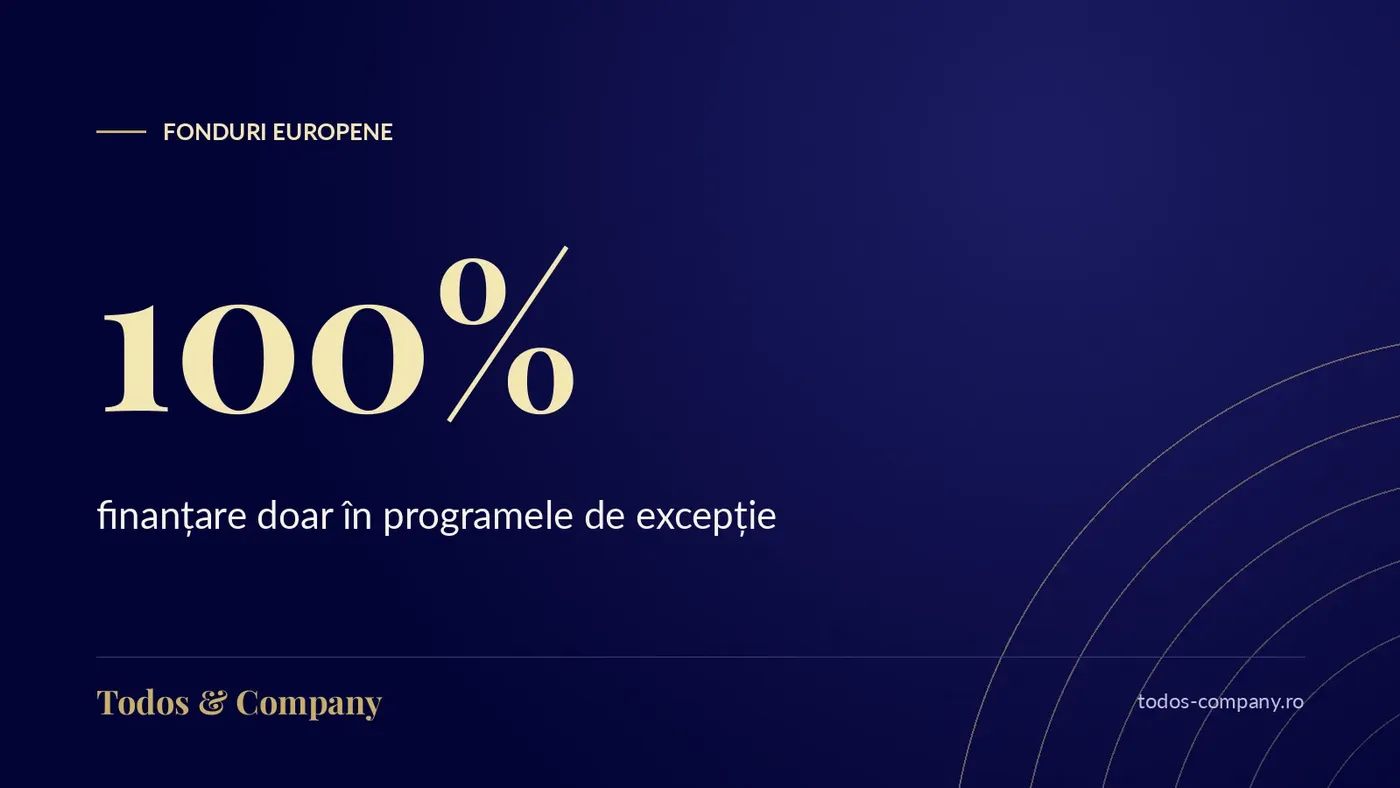
Funding of 100% of eligible costs is an exception. For companies, the rule is own co-financing. Of the programmes we have checked now, only two reach 100%: the Modernisation Fund call for solar with storage, aimed at public entities (up to €10 million per beneficiary, submission between 28 September and 20 November 2026), and EIC Pathfinder Challenges (100% of eligible costs, deadline 28 October 2026). PFAs (sole traders), individual enterprises and family businesses can mainly seek funding through the AFIR interventions for farmers, for example DR-14, which covers a maximum of 85% of no more than €50,000.
In brief
- Definition: "without co-financing" means the support intensity is 100% of eligible costs. Ineligible costs still remain the beneficiary's responsibility.
- 100% for public institutions: Modernisation Fund, solar with storage (€500 million) and storage (€150 million), maximum €10 million per beneficiary.
- 100% for research: EIC Pathfinder Challenges, budget of €96 million, EU contribution considered appropriate of up to €4 million per project.
- PFA / II / IF: eligible under DR-14 (maximum 85%, up to €50,000) and DR-12 (80% for young farmers, 65% for others, up to €200,000).
- Natural persons without authorisation: not eligible under either DR-14 or DR-12.
- Payment principle: with AFIR, the money is paid by reimbursing expenses that the beneficiary has already paid.
What does "100% non-refundable" actually mean?
Support intensity shows what percentage of eligible costs the funder covers. At 100%, the funder covers the eligible costs in full. This does not mean you need no money of your own. Ineligible costs remain yours. In addition, with reimbursement-based programmes you must first pay the supplier and only then receive the money back. The DR-14 guide states explicitly: "The basic principle of non-refundable funding is the reimbursement of eligible expenses incurred (actually borne and paid) beforehand by the beneficiary".
Most often, 100% appears in three situations: for public beneficiaries, for research projects funded directly by the European Commission, and for lump sums or small vouchers. Companies' productive investments are state aid and almost always receive a lower intensity.
Which programmes currently cover 100% of eligible costs?
Solar with storage for town halls and public institutions
AFIR receives applications between 28 September 2026, 10:00 and 20 November 2026, 23:59, via depunerepspac.afir.ro. There are two calls:
- solar production with integrated storage, for self-consumption: €500 million, maximum 100% of eligible costs, a ceiling of €10 million per beneficiary and €900,000/MW (€1,100,000/MW if the project includes heat pumps);
- new storage capacity for electricity produced from renewable sources, for public entities: €150 million, up to 100%, a ceiling of €10 million per beneficiary and a maximum of €200,000 per MWh installed.
Applications are assessed in the order of submission, until the allocation of each call is exhausted. You can find details on the programme page.
EIC Pathfinder Challenges (Horizon Europe)
The EIC 2026 work programme states that "the funding rate of this grant will be 100% of eligible costs", in the form of a lump sum. The call budget is €96 million. The Commission considers an EU contribution of up to €4 million per project appropriate. The deadline is 28 October 2026, 17:00 (Brussels time). Consortia or a single legal entity may apply. The programme lists universities, research organisations, SMEs, start-ups and natural persons as examples. Mid-caps and large companies cannot apply on their own. Projects start from an early technology readiness level (TRL 2) and go up to laboratory validation (TRL 3–4).
Be careful with comparisons: under EIC Accelerator, the grant component reimburses a maximum of 70% of eligible costs, with a ceiling of €2,499,999. The fact that a programme is EU-funded does not automatically mean 100%.
What funding can PFAs access?
DR-14 AFIR: small farms, up to €50,000
The DR-14 guide explicitly lists among eligible beneficiaries the authorised natural person (PFA), the individual enterprise and the family enterprise (OUG 44/2008), alongside SRL, SNC, SCS, SA and SCA. Natural persons without authorisation are excluded. The main conditions:
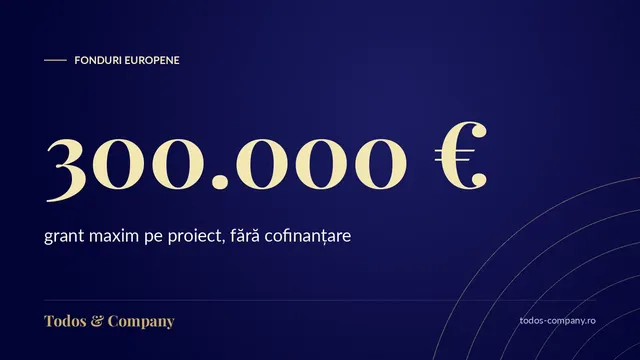
- public support of a maximum of €50,000 per project and a maximum of 85% of eligible costs; the remaining at least 15% is the private contribution;
- the economic size of the farm must be between €4,000 and €11,999 SO. The threshold drops to €2,000 SO for livestock farms with native breeds and for flowers and aromatic, medicinal or ornamental plants, and for vegetables it is €2,300 SO;
- the applicant must be registered with APIA/ANSVSA under the form of organisation for which they are requesting support;
- proof of co-financing (bank statement or loan contract) must be submitted within 6 months of approval of the selection report; for projects with simple procurement, the guide sets a maximum of 3 months in another chapter.
The call window is open from 1 September to 31 October 2026. Details on the DR-14 page.
DR-12 AFIR: young farmers and farmers up to 45 years old
The final DR-12 guide was published on 18 September 2026. PFAs, IIs, IFs and SRLs are eligible where the young farmer is sole associate and administrator, or majority associate and sole administrator. The guide is clear: "Natural persons are not eligible to access DR 12". The maximum support is €200,000 per project. The intensity is 80% for young farmers and 65% for other categories of beneficiaries. On the AFIR page for the intervention, at the time of checking, the dates of the submission call window were not displayed.
Common mistakes
- Confusing "non-refundable" with "no contribution". DR-14 is non-refundable, but it covers 85%. For an eligible investment of €58,824, the maximum grant is €50,000, and the farmer pays the €8,824 plus the ineligible costs.
- Applying as a natural person without authorisation. The PFA must be set up and registered with APIA before submission.
- Lack of liquidity. Even at 100%, with AFIR you pay first and get the money back afterwards.
- Creating artificial conditions. For example, splitting a farm to fall under the ceiling. AFIR guides provide for rejection of the application or recovery of the money.
What this means for your business
Our recommendation: do not choose a programme just because it promises 100%. For an ordinary SME, full funding comes almost exclusively from Pathfinder-type research, which requires a risky scientific project and usually a research partner. If you are a town hall, the solar with storage call is the most accessible 100% programme at the moment. Because assessment is done in the order of submission, it matters to have your technical documentation ready from the first days.
If you are a PFA or II in agriculture, prepare three things now: registration with APIA under the form of organisation you are applying with, the calculation of economic size (SO), and a bank statement or loan commitment for your own share. If you are not sure which programme suits you, the eligibility check shows you in a few minutes what applies to your form of organisation.
Frequently asked questions
Are there 100% non-refundable EU funds for companies?
Yes, but few. Of the programmes checked now, EIC Pathfinder Challenges covers 100% of eligible costs for early-stage research projects, with a deadline of 28 October 2026. Companies' ordinary productive investments have lower intensities, for example 85% under DR-14 or 70% under the EIC Accelerator grant.
Can a PFA obtain EU funds?
Yes, in agriculture. The AFIR guides for DR-14 and DR-12 explicitly list the PFA, the individual enterprise and the family enterprise among eligible beneficiaries. The PFA must be registered with APIA/ANSVSA before submission.
Can I apply as a natural person, without a PFA?
Under DR-14 and DR-12, no: both guides exclude natural persons. EIC Pathfinder mentions natural persons among the entities that can take part, but the project must be deep-tech research and meet the European Commission's conditions.
If the project is funded at 100%, do I still need my own money?
As a rule, yes. Ineligible costs remain the beneficiary's responsibility. With reimbursement-based programmes, such as those managed by AFIR, you must first pay the invoices and only then receive the money back.
Can town halls receive 100% for solar panels?
Yes. The Modernisation Fund call for public entities covers a maximum of 100% of eligible costs, up to €10 million per beneficiary. Applications are submitted to AFIR between 28 September and 20 November 2026 and are assessed in the order of submission.
Official sources
- AFIR – Applicant's guide DR-14, 2026 call window
- AFIR – DR-12, details and annexes
- AFIR – Applicant's guide DR-12
- AFIR – Information on the renewable energy call window for public applicants
- European Commission – EIC Work Programme 2026
- EIC – Pathfinder Challenges 2026
Information checked on 27 September 2026. Conditions may be amended by the managing authority — check the guide in force before submitting.