EIT HEI 2026: up to €1.25 million for universities and deep-tech firms, deadline 13 January
On 20 October 2026, the EIT launched a €40 million call for consortia of universities and firms in deep tech and advanced manufacturing: up to €1.25 million per project, submission by 13 January 2027.
Todos & Company editorial team · EU funding consultancy since 2006
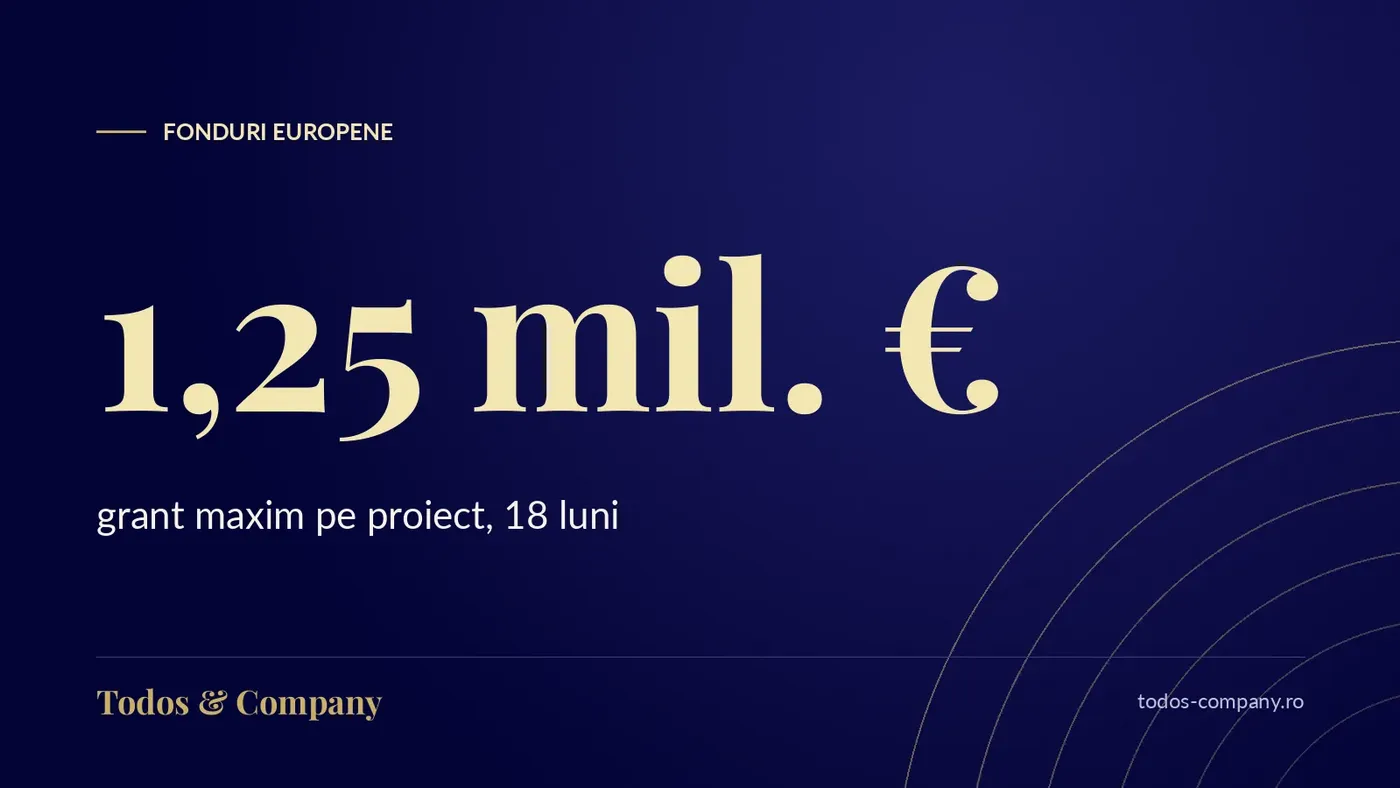
On 20 October 2026, the European Institute of Innovation and Technology (EIT) launched a new call under the EIT Higher Education Initiative (HEI), with a budget of 40 million euro, for consortia of universities and firms that want to turn research into deep-tech innovation and advanced manufacturing. Each selected project can receive up to 1.25 million euro over 18 months. Applications must be submitted by 13 January 2027, 17:00 (Central European Time).
A university leads the project, but each consortium must include at least two business partners. For SMEs, start-ups and larger firms in Romania working in technology or advanced manufacturing, this is the opportunity: they can join the project as funded partners.
In brief
- Programme: EIT Higher Education Initiative, 2026 call (Call 6), part of Horizon Europe
- Authority: European Institute of Innovation and Technology (EIT)
- Beneficiaries: consortia of at least 5 funded partners: at least 3 higher education institutions from 3 countries eligible under Horizon Europe and at least 2 business partners
- Total budget: €40 million
- Value per project: up to €1.25 million, over 18 months
- Submission period: 20 October 2026 – 13 January 2027, 17:00 CET
- Status: call open; results are expected in March 2027, and projects start on 1 May 2027
Who can apply and how should the consortium be built?
The lead applicant must be a higher education institution. The consortium has at least five funded partners, as follows:
- at least three higher education institutions, from three different countries eligible under Horizon Europe, at least one of which is from an EU member state;
- at least two business partners or organisations representing them: SMEs, start-ups, large companies, industry associations. The EIT explicitly encourages partners from advanced manufacturing and deep tech.
Research organisations, technology transfer offices, public authorities, innovation intermediaries, social enterprises and NGOs may also take part. The call page also provides for a category of associated partners, with a separate letter of commitment.
There are two important restrictions. Organisations funded as beneficiaries in the EIT HEI 2025 call (Cohort 5) cannot be funded beneficiaries in the 2026 call. According to the EIT press release, each organisation may be a funded beneficiary in only one application in 2026.
Which activities are funded?
The project must pursue all three objectives of the call: developing STEM talent for deep-tech innovation and manufacturing, strengthening universities' innovation capacity and connecting them to regional and European innovation ecosystems. The types of activities mentioned in the call are:
- drawing up and implementing an innovation action plan;
- entrepreneurship and innovation programmes;
- training, mentoring and capacity building;
- creating or strengthening innovation structures;
- developing partnerships and the ecosystem;
- technology transfer and knowledge valorisation.
The funding rate and detailed budget rules are set out in the full text of the call and in the budget template published on the EIT HEI website. Check them there before you build your budget.
How and by when do you apply?
The application is submitted online, via the Seedbook portal indicated on the call page, by 13 January 2027, 17:00 CET. The file comprises the narrative part (Part B), the budget, the letters of commitment and the declaration on honour, using the published templates. To help you find partners, the EIT provides a matchmaking platform.
The online information sessions scheduled are as follows:
- 4 November: overview of the call;
- 6 November: HEInnovate;
- 11 November: monitoring and evaluation framework;
- 13 November: expected performance indicators;
- 17 November: the application and the budget;
- 23 November: EIT KIC Discovery Day;
- 3 December: open questions and answers session.
What this means for your business
Our recommendation: for a company in Romania, the realistic way in is the role of business partner, alongside a university you already work with on research, internships or recruitment. The call suits best a firm that has a technology product, an advanced production line or a constant need for engineers. Its role in the project can be concrete: real problems brought to students, mentors, pilots and market access for the start-ups created in the project.
What you can do from November:
- discuss with your partner university whether it is joining a HEI 2026 consortium, and check that it was not a beneficiary in the 2025 cohort;
- establish from the start what the firm's contribution is and what it receives in return (talent, technology transfer, visibility);
- follow the session on indicators on 13 November: projects are measured on results, and unrealistic targets weigh against you at evaluation and during implementation;
- do not commit as a funded partner in several applications, because an organisation can be a funded beneficiary in only one application.
The most common pitfall in calls of this type is a consortium put together at the last moment, in which the private partner's role remains vague. The time until January is short, so it is worth starting now. If you want to know first which other funding schemes suit your firm, use the eligibility check.
Frequently asked questions
Can a company from Romania lead an EIT HEI project?
No. The lead applicant must be a higher education institution. Firms join the consortium as business partners, and each consortium must have at least two such funded partners.
Are universities from Romania eligible?
Yes. The call requires higher education institutions from countries eligible under Horizon Europe, with at least one from an EU member state, and Romania is an EU member state. Romanian universities can be either lead applicant or partner.
How much does a project receive and how long does it last?
Each selected project can receive up to 1.25 million euro, for an implementation period of 18 months. According to the call timetable, projects start on 1 May 2027 and end on 31 October 2028.
Can an organisation funded in the EIT HEI 2025 call take part?
Not as a funded beneficiary. The call rules exclude from the role of funded beneficiary in 2026 the organisations funded as beneficiaries in Cohort 5, that is, in the 2025 call.
When will the results be known?
The call page announces the evaluation results for March 2027. The submission deadline is 13 January 2027, 17:00 CET.
Official sources
- EIT – press release on the launch of the €40 million call (20 October 2026)
- EIT Higher Education Initiative – 2026 call page, documents and information sessions
- EIT HEI Call 6 – full text of the call (PDF)
Information checked on 23 October 2026. Conditions may be changed by the managing authority — check the guide in force before you submit.