MSCA Doctoral Networks 2026: €593 million for doctorates with companies, deadline 24 November
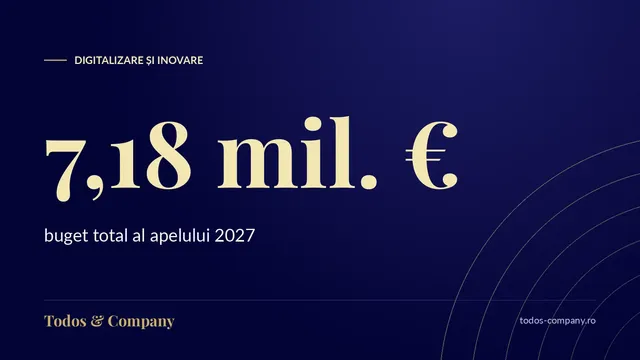
The MSCA Doctoral Networks 2026 call has €593.03 million for around 130 international doctoral networks and is open until 24 November 2026. Companies, including SMEs, can be partners.
Todos & Company editorial team · EU funding consultancy since 2006

Of the Marie Skłodowska-Curie Actions (MSCA) calls with a 2026 budget, the only one still open on 27 September 2026 is Doctoral Networks: €593.03 million for international doctoral training networks, with submission until 24 November 2026. Universities, research institutes and organisations from outside academia, including companies and SMEs, can take part. The 2026 COFUND, Staff Exchanges and Postdoctoral Fellowships calls have already closed.
In brief
- Programme: Horizon Europe – Marie Skłodowska-Curie Actions (MSCA), Doctoral Networks 2026 call
- Authority: European Commission, through the European Research Executive Agency (REA)
- Beneficiaries: consortia of universities, research institutes and infrastructures, companies (including SMEs) and other socio-economic actors
- Total budget: €593.03 million, for more than 130 projects and approximately 1,950 doctoral candidates
- Submission period: 28 May – 24 November 2026, on the Funding & Tenders Portal
- Results: April 2027 (provisional); project start: September 2027 (provisional)
- Status: call open
What happened to the 2026 MSCA budget
In December 2025, the European Commission announced more than €1.25 billion for MSCA in 2026, the year in which the actions turn 30. The budget was split across calls with different timetables:
- COFUND – €105.46 million, call closed on 8 April 2026;
- Staff Exchanges – €97.92 million, call closed on 16 April 2026;
- Postdoctoral Fellowships – €399.05 million, call closed on 9 September 2026;
- Doctoral Networks – €593.03 million, open until 24 November 2026;
- Choose Europe for Science – €51.25 million, with opening announced for 8 December 2026 and a deadline of 6 April 2027.
If you missed the calls that have already closed, the realistic option is to prepare for the next call windows, based on the 2026–2027 MSCA work programme published by the Commission.
Who can apply to Doctoral Networks?
The project is submitted by a consortium that must include at least three independent legal entities, from different EU Member States or countries associated to Horizon Europe, at least one of which must be from a Member State. Organisations from any other country can also join the consortium.
The call supports three types of networks:
- Standard doctoral networks – the consortium recruits doctoral candidates and trains them through international, interdisciplinary and intersectoral exposure;
- Industrial doctorates – doctoral candidates spend at least 50% of their time outside academia and are jointly supervised by an academic partner and a non-academic one;
- Joint doctorates – the participating institutions award a joint doctoral degree or multiple degrees.
Projects last up to 4 years (5 years for joint doctorates). Recruited doctoral candidates must meet the mobility rule: they must not have resided or carried out their main activity in the country of the recruiting organisation for more than 12 months in the 36 months before recruitment.
What is funded?
The funding covers the doctoral candidates' living, mobility and special allowances, research, training and networking activities, as well as management and indirect costs. The evaluation looks at the quality and novelty of the methodologies, research, training, supervision and career guidance.
New in 2026 is the RAISE Doctoral Networks for AI in Science pilot, with additional funding for projects that integrate artificial intelligence into scientific research. Details of the pilot can be found in the call documentation on the portal.
How and by when do you apply?
The application is submitted exclusively online, on the European Commission's Funding & Tenders Portal, by 24 November 2026. The exact closing time must be checked on the call page on the portal. The provisional timetable announced by the Commission: results in April 2027, contract signing in July 2027, project start in September 2027.
What this means for your business
Our recommendation: MSCA is not an investment grant for SMEs, but a tool for training researchers. Even so, a company with research and development activity has a real role in a consortium, especially in industrial doctorates, where the doctoral candidate works at least half of their time in the non-academic sector. For the company, the concrete gain is access to a researcher trained on a topic relevant to its products and to a European network of universities.
- Who it suits: technology companies, spin-offs and companies with an R&D department that already collaborate with universities.
- What to do now: contact a Romanian or foreign university that is coordinating a proposal and ask for a partner role; two months before the deadline, consortia are usually almost closed.
- Common pitfalls: failing to meet the mobility rule at recruitment, an unclear joint supervision plan in industrial doctorates, and the lack of a concrete description of the non-academic partner's contribution.
If you are looking for direct non-refundable funding for your company's investments, you can start with the eligibility check.
Frequently asked questions
Can you still apply to MSCA Postdoctoral Fellowships 2026?
No. The Postdoctoral Fellowships 2026 call, with a budget of €399.05 million, closed on 9 September 2026. The COFUND (8 April 2026) and Staff Exchanges (16 April 2026) calls have also closed.
Can a Romanian SME take part in an MSCA doctoral network?
Yes. The European Commission states that private-sector organisations, including companies and SMEs, can take part in Doctoral Networks as part of a consortium of at least three entities from different countries.
How much time does a doctoral candidate spend at the company in an industrial doctorate?
In industrial doctorates, the doctoral candidate must spend at least 50% of their time outside academia and is jointly supervised by an academic partner and a non-academic one.
When will the results be known?
According to the provisional timetable, the results of the Doctoral Networks 2026 call are expected in April 2027, and projects are due to start in September 2027.
Which MSCA call comes after Doctoral Networks?
The Commission has announced the Choose Europe for Science call, with a budget of €51.25 million, scheduled to open on 8 December 2026, with a deadline of 6 April 2027.
Official sources
- MSCA – announcement of the €1.25 billion budget for 2026 and the call timetable
- MSCA – Doctoral Networks 2026 call opens for submission
- MSCA – Doctoral Networks action page (eligibility conditions)
- REA – MSCA Doctoral Networks
Information checked on 27 September 2026. Conditions may be amended by the managing authority — check the guide in force before submitting.