EU Fund Reimbursement: Payment Requests, Reimbursement Requests, Deadlines and Obligations
Guide to implementing 2021–2027 projects: payment request verified within 20 working days, reimbursement within 10 days, the advance, payment within 80 days and the 5-year sustainability period (3 years for SMEs).
Todos & Company editorial team · EU funding consultancy since 2006
Signing the funding contract is only half the journey. EU money is paid on a reimbursement basis: the beneficiary incurs the cost, documents it, then recovers it through a reimbursement request or a payment request. For 2021–2027 programmes financed from the ERDF, ESF+, the Cohesion Fund and the Just Transition Fund (the regional programmes, PoCIDIF, PEO, PDD, PTJ and the others), the rules are set by OUG 133/2021 and Regulation (EU) 2021/1060. The guide below sets out the steps, deadlines and obligations that remain after your project is completed.
In brief
- What reimbursement means: recovering eligible costs from the managing authority, through a reimbursement request (after you have paid) or a payment request (for invoices received but not yet paid).
- Legal acts: OUG 133/2021 (approved by Law No. 231/2023) and Regulation (EU) 2021/1060.
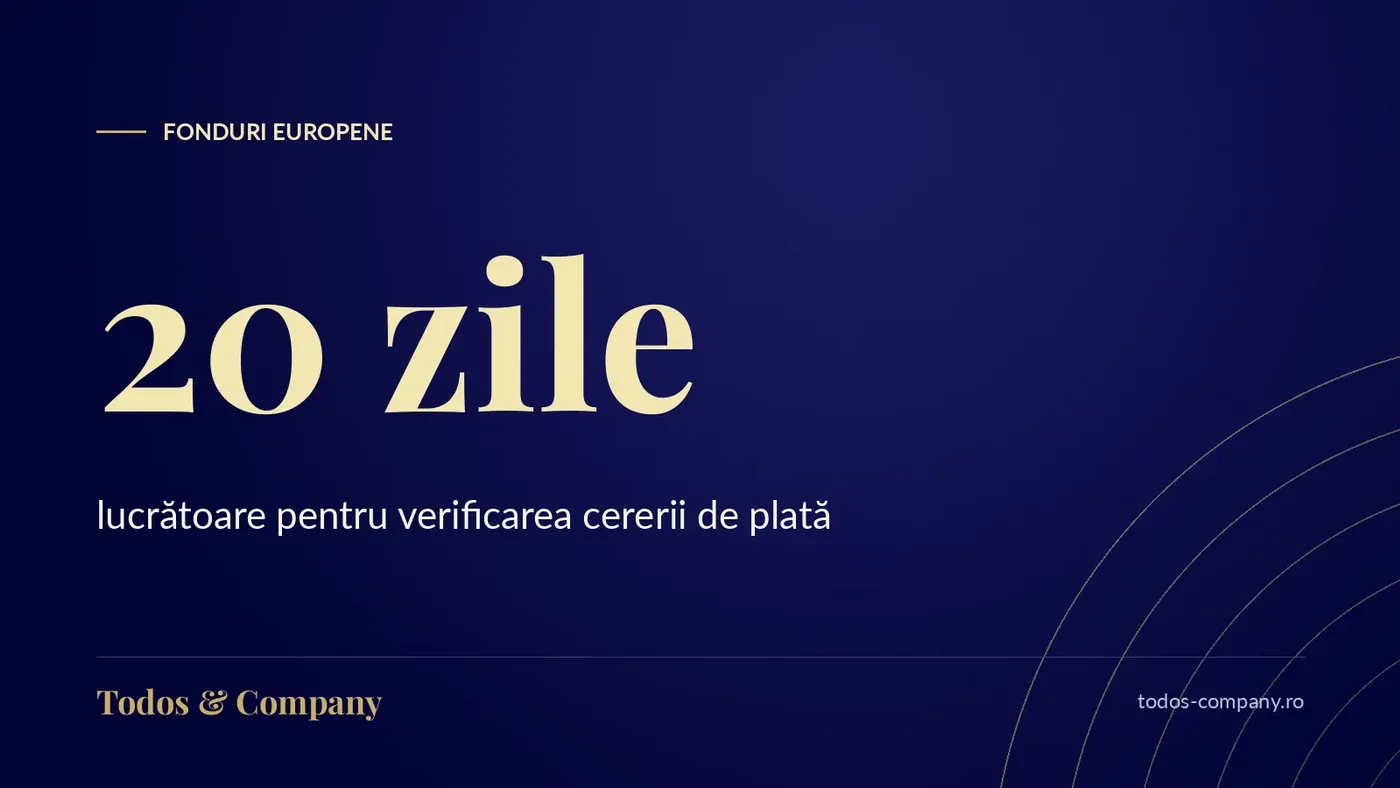
- Checking the payment or reimbursement request: a maximum of 20 working days. The deadline may be suspended for clarifications for no more than 10 working days in total.
- Reimbursement request linked to a payment request: must be submitted within a maximum of 10 working days of receiving the money.
- Pre-financing (advance): up to 30% of the eligible value. For state aid or de minimis aid, up to 40% of the total value of the aid, against a guarantee. At least 50% of the instalment must be justified within 90 calendar days.
- Payment: no later than 80 days after the payment request is submitted, subject to the availability of funds, in accordance with the EU regulation.
- After completion: the investment must be maintained for 5 years from the final payment (3 years for SMEs, if the state has shortened the period). Documents are kept for 5 years from 31 December of the year of the last payment.
How do the reimbursement request and the payment request work?
OUG 133/2021 allows managing authorities to use both mechanisms (art. 21).
The reimbursement request is the traditional mechanism. You pay the supplier from your own funds or from a loan, then claim the money back. Under art. 25, the managing authority authorises the costs within a maximum of 20 working days of submission. Payment is made within 3 working days from the moment the authority has the money in its account.
The payment request spares you from financing the investment on your own. Under art. 22, once you receive the invoice for goods delivered, services provided or works received and accepted for payment, you submit the payment request together with the supporting documents. The authority checks it within a maximum of 20 working days. It then transfers the amount within 3 working days of having the resources, into a separate account opened in your name with the Treasury. Your obligations start from this point:
- the own contribution relating to the costs in the request must be paid in full no later than the date the reimbursement request is submitted (art. 22 para. 6);
- within a maximum of 10 working days of receipt, you submit the reimbursement request relating to the payment request (art. 22 para. 10);
- the money received may only be used for the purpose for which it was granted.
Failing to submit the reimbursement request within 10 working days is a breach of contract, and the authority may decide to terminate it (art. 22 para. 12). Unjustified amounts must be returned.
Worked example: the advance and the 90-day deadline
Take a company with de minimis aid of 700,000 lei. Under art. 18 para. (2) of OUG 133/2021, as amended in 2024, it may receive pre-financing of up to 40% of the total value of the aid, that is 280,000 lei. The condition is that it submits a letter of guarantee, from a bank, a non-bank financial institution or an insurance company, for the whole amount requested.
Within a maximum of 90 calendar days of the advance being transferred, the company must submit reimbursement requests justifying at least 50% of the instalment, that is a minimum of 140,000 lei spent (art. 18 para. 7). If it fails to do so, the advance is returned in full or in part. For amounts not returned within 15 days of notification, the authority issues a recovery decision, which constitutes a debt title (art. 20). Apart from the first instalment, each new instalment is granted after unjustified amounts from the previous instalment have been deducted.
Our recommendation is to request the advance only once you have signed contracts with suppliers and a realistic delivery schedule. An advance received too early easily turns into a debt.
Procurement: where beneficiaries most often go wrong
Private beneficiaries (companies) buy through the competitive procedure in Order No. 1284/2016. Notices are published in the "Private Beneficiaries Procurement" (Achiziții Beneficiari Privați) application. In July 2026, the order was amended by MIPE Order No. 1143/2026: if the platform is unavailable for reasons beyond the beneficiary's control, all procedure deadlines are extended by the period of unavailability. Town halls and other contracting authorities apply public procurement legislation.
The mistakes that lead to financial corrections usually occur here:
- technical specifications that point to a particular brand or supplier;
- contracts signed before the procedure is completed or without publishing the result;
- qualification requirements that are disproportionate to the value of the contract;
- changing the subject matter or price of the contract after signing.
What does the managing authority check?
Under art. 74 of Regulation (EU) 2021/1060, the managing authority carries out risk-based management verifications: administrative checks of payment requests and on-the-spot checks. Assessors look at whether the goods and services were actually delivered, whether the operation complies with the law, the programme and the contract conditions, and whether you keep separate accounting records or distinct accounting codes for the project.
Some eligibility rules from the regulation that are checked at reimbursement:
- costs are eligible if they were paid by 31 December 2029 (art. 63);
- VAT is eligible for operations with a total cost below 5,000,000 euro, including VAT. Above this threshold, it is eligible only if it cannot be recovered (art. 64);
- land is eligible up to 10% of total eligible costs (15% for abandoned or former industrial sites).
If you do not send the requested clarifications within the deadline set in the contract, the request may be rejected in part or in full (art. 25 para. 5). For the final reimbursement request, the verification deadline may be extended as needed. However, the EU regulation requires that the beneficiary receive the full amount, subject to the availability of funds, within a maximum of 80 days of submitting the request, without any deductions, retentions or specific charges. The deadline may be suspended only if the documents submitted do not allow the amount due to be determined.
What obligations remain after the final payment?
Durability. For infrastructure or productive investments, the support is recovered if, within 5 years of the final payment, one of the situations in art. 65 of Regulation 2021/1060 arises:
- you cease the productive activity or relocate it outside the NUTS 2 region that received the support;
- ownership of an item of infrastructure changes, and the change gives an undue advantage;
- the project undergoes a substantial change affecting its nature, objectives or implementation conditions.
For maintaining investments or jobs created by SMEs, the state may reduce the period to 3 years. State aid rules may impose a different period, so check the guide for your call. The amount recovered is proportionate to the period during which you failed to meet the conditions.
Archive. Supporting documents are kept for 5 years from 31 December of the year in which the managing authority made its last payment to you (art. 82). The period is suspended if legal proceedings begin or if the Commission requests it. State aid rules may impose a longer period. During this period, the audit authority may carry out checks. For ERDF operations below 400,000 euro, the regulation limits auditing to no more than one audit before the submission of accounts for the year in which the operation is completed.
What this means for your business
Our recommendations, based on the projects we have implemented:
- Draw up a financial calendar before signing. Put on one sheet the invoice dates, the 20 working days of verification and the 10 working days for reimbursement. The cash gap must be covered by your own contribution or a credit line.
- Use the payment request for expensive equipment. You no longer finance the whole machine yourself, but you must have your own contribution ready when the money arrives.
- Open a separate analytical account for the project from day one. Reconstructing records at reimbursement takes time and leads to rejected costs.
- Do not change the activity or registered office during the durability period without the managing authority's consent.
If you do not yet know whether your company fits a programme, start with the eligibility check.
Frequently asked questions
What is the difference between a payment request and a reimbursement request?
You submit the reimbursement request after you have paid your supplier and want to recover your money. The payment request is submitted on invoices that have been received but not yet paid: the authority transfers the non-refundable portion, and you then pay the supplier and submit the corresponding reimbursement request within 10 working days of receiving the funds.
How long does it take to receive the money after I submit a reimbursement request?
Under Article 25 of OUG 133/2021, the managing authority authorises the expenditure within 20 working days at most. The deadline may be suspended for clarifications for no more than 10 working days in total. Payment is made within 3 working days of the authority having the funds available. The EU Regulation provides for payment within 80 days at most of submission, subject to the availability of funds.
How much advance payment can I receive, and what happens if I do not spend it?
The general rule is a maximum of 30% of the eligible value. For projects with state aid or de minimis aid, the advance may reach 40% of the aid value, with a guarantee. You must justify at least 50% of the instalment within 90 calendar days. Otherwise, the advance must be returned, and any amount not repaid is recovered through a recovery decision, with interest.
How long must I keep the investment after the project is completed?
The rule under Regulation (EU) 2021/1060 is 5 years from the final payment. For investments and jobs created by SMEs, the period may be reduced to 3 years, and state aid rules may set a different period. The exact period appears in the applicant's guide and in your funding contract.
Is VAT an eligible cost?
Yes, for operations with a total cost below 5,000,000 euro, including VAT. Above this threshold, VAT is eligible only if it cannot be recovered under national VAT legislation.
Official sources
- OUG No. 133/2021 on the financial management of EU funds 2021–2027 (Legislative Portal)
- OUG No. 133/2021, consolidated text (ADR Vest)
- OUG amending and supplementing OUG No. 133/2021 (General Secretariat of the Government, 2024)
- Regulation (EU) 2021/1060 on common provisions (EUR-Lex)
- Order No. 1284/2016 has been amended (ADR South-West Oltenia)
- The "Private Beneficiaries Procurement" application is working again (ADR North-East)
Information checked on 27 September 2026. Conditions may be amended by the managing authority — check the guide in force before submitting.