
Start-Up Nation: 2,500 lei threshold for equipment, 3,140 contracts and a new call window
MEDAT has kept the 2,500 lei threshold for eligible equipment in Start-Up Nation (Order 480/2026), has begun signing 3,140 contracts and on 6 October 2026 opened a new call window of courses for young people aged 18–29.
Todos & Company editorial team · EU funding consultancy since 2006
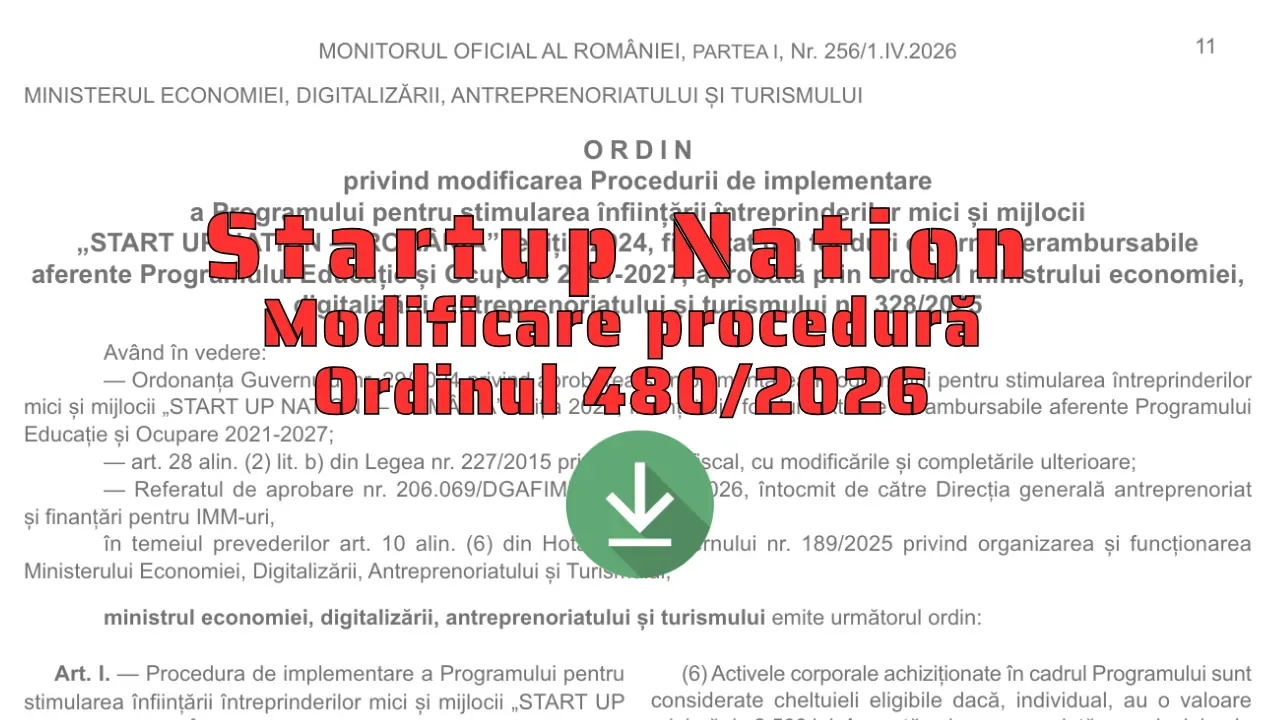
In spring 2026, the Ministry of Economy, Digitalisation, Entrepreneurship and Tourism (MEDAT) resolved the fixed-asset threshold problem in the Start-Up Nation România programme, 2024 edition: under Order no. 480/2026, equipment worth at least 2,500 lei remains eligible, regardless of the new fiscal threshold of 5,000 lei introduced by OUG 8/2026. Meanwhile, the programme has reached the contracting stage: from 28 September 2026, 3,140 funding agreements from the first call window are being signed, and on 6 October 2026 a new call window opened for enrolment in entrepreneurship courses, with 17,600 places for young people aged 18–29. Companies set up by graduates can obtain a grant of up to 250,000 lei, covering no more than 90% of eligible costs.
In brief
- Programme: Start-Up Nation România, 2024 edition (fourth edition), financed from the Education and Employment Programme (PEO) 2021–2027 (ESF+) and the state budget
- Authority: MEDAT, through the Agencies for SMEs and Tourism (AIMMT); platform minimis.imm.gov.ro
- Beneficiaries: Pillar I – young people from 18 up to the age of 30 (not yet 30); Pillar II – people from 30 up to the age of 35 (not yet 35) (the Pillar II places were used up in the first call window)
- Value per project / intensity: maximum 250,000 lei, no more than 90% of eligible costs; own co-financing of at least 10%
- Equipment threshold: 2,500 lei per tangible asset, retained by Order 480/2026 (Official Gazette no. 256 of 1 April 2026)
- Submission period: the second call window for course enrolment began on 6 October 2026 at 10:00 and stays open for 30 days, with the possibility of extension until the places are filled
- Status: first call window – in contracting (3,140 contracts, approximately 800 million lei); second call window – course enrolment under way
What happened to the fixed-asset threshold?
The programme procedure, approved by Order no. 328/2025, defines technological equipment as tangible assets with a minimum value of 2,500 lei, classified under groups 2.1, 2.2 and 2.3.6 of the Catalogue on the classification and normal operating lives of fixed assets (HG no. 2.139/2004). Thousands of companies built their business plans on this rule, with submissions starting on 1 October 2025.
On 25 February 2026, OUG no. 8/2026, the economic relaunch package, entered into force and raised to 5,000 lei the minimum fiscal value from which an asset is considered a depreciable fixed asset. For Start-Up Nation applicants, this created a risk that equipment bought for between 2,500 and 5,000 lei might be rejected at reimbursement because it was no longer a "fixed asset" in the fiscal sense.
MEDAT intervened through Order no. 480 of 27 March 2026, published in Official Gazette no. 256 of 1 April 2026. The consolidated procedure now provides that the 2,500 lei threshold applies to tangible assets purchased as a minimum eligibility threshold, independent of tax and accounting treatment, for all applications submitted under the 2024 edition. The requirement for the asset to be classified in the accounts as a fixed asset has been removed. The exceptions to the threshold remain the same: electronic signature, set-up costs, tablets, mobile phones and information plaques. Assets of at least 2,500 lei for playgrounds, sports halls, fitness, drones or strength-training equipment are treated as equipment.
Where has the first call window got to?
The submission of business plans by companies set up by course graduates began on 1 October 2025 and closed on 29 May 2026. According to MEDAT data cited by the specialist press, 7,923 companies applied for funding, of which 5,413 under Pillar I and 2,510 under Pillar II, and the lists from the automatic evaluation were published on 4 June 2026.
On 28 September 2026, the ministry announced the start of contract signing for 3,140 beneficiaries, with budget resources of approximately 800 million lei at this stage. The steps are strict: the beneficiary downloads the document granting the non-refundable financial allocation from the minimis.imm.gov.ro application, signs it electronically and uploads it again together with proof of co-financing (bank statement, loan approval letter or loan contract) within a maximum of 40 days from receiving the admission decision. Exceeding the deadline leads to rejection of the funding. After signing, MEDAT transfers to the partner banks 50% of the value of the grants, approximately 400 million lei, and the banks have seven working days to transfer the amounts into the beneficiaries' dedicated accounts.
Who can enrol in the second call window, and how?
The second call window concerns Pillar I only. According to the MEDAT press release of 30 September 2026, enrolment in the free entrepreneurship courses began on 6 October 2026 at 10:00 on minimis.imm.gov.ro and stays open for 30 days, with the possibility of extension until the places are filled and a reserve list is drawn up. The 17,600 places are divided as follows:
- 950 places for young people aged 18–29 from Bucharest-Ilfov;
- 300 places for young Roma people from Bucharest-Ilfov;
- 13,500 places for young people aged 18–29 from the less developed regions (all regions other than Bucharest-Ilfov);
- 2,850 places for young Roma people from the less developed regions.
Conditions: aged between 18 and 29 and at least lower secondary education completed (ISCED 2). Young people returning from the diaspora may also take part, regardless of their labour-market status. The course lasts 40 hours, online or face to face, and ends with a certificate recognised by the Ministry of Labour. Only after graduation is the company set up and the business plan submitted for the grant of up to 250,000 lei. The timetable for submitting business plans for this call window has not yet been announced.
Which implementation rules do you need to know?
Order no. 280/2026 (Official Gazette no. 167 of 4 March 2026) introduced the implementation rules applicable to all beneficiaries: a maximum of 12 months from the contract entering into force to incur all expenditure and submit the reimbursement request; an advance of up to 50% of the grant in dedicated accounts at the partner bank; an obligation for beneficiaries without a loan to deposit in full the difference up to the total eligible value before the first payment; and the possibility of changing the partner bank only until the contract enters into force. The specialist press has reported that a later order, no. 922/2026 of June 2026, moved the absolute final deadline for completing expenditure to 8 December 2027; check the text of the procedure in force before planning your purchases.
What this means for your business
Our recommendation for the 3,140 beneficiaries from the first call window: treat the 40-day deadline as the riskiest moment of the project. Proof of co-financing must exist when you re-upload the contract, so discussions with the bank or funding of the account should happen now, not after signing. Then check every item in the business plan against the 2,500 lei per asset rule and groups 2.1, 2.2 and 2.3.6 of the Catalogue; a 3,000 lei piece of equipment is eligible, but it must be in the correct groups and linked to the funded CAEN code.
For young people enrolling in the second call window, the course is only the entry gate. In the first call window, the number of companies that applied for funding exceeded the places available under Pillar I, so the score in the evaluation grid makes the difference. Choose your activity, the jobs you commit to creating and the structure of the investment well in advance. If you are not sure you qualify, use the eligibility check before enrolling on the course.
Common pitfalls, in the opinion of our consultants: purchases under 2,500 lei artificially grouped into a single "piece of equipment", assets that do not appear in the Catalogue groups, co-financing without bank backing, and exceeding the 12-month implementation period because of delayed deliveries.
Frequently asked questions
Is a 4,000 lei piece of equipment still eligible in Start-Up Nation after OUG 8/2026?
Yes. Under Order 480/2026, the Start-Up Nation procedure applies the 2,500 lei threshold per tangible asset independently of tax and accounting treatment, for all applications submitted in the 2024 edition. The fact that the asset is no longer a depreciable fixed asset in the fiscal sense does not make it ineligible in the programme.
How much is the grant and how much do I have to contribute?
The grant is a maximum of 250,000 lei per company and covers no more than 90% of eligible costs. The beneficiary provides at least 10% own co-financing, from own funds or from a loan, and proof of co-financing is submitted together with the signed contract.
Can I enrol in the second call window if I am 32?
No. The call window opened on 6 October 2026 is dedicated exclusively to Pillar I, that is, young people aged 18–29. The Pillar II places (30 up to the age of 35) were used up in the first call window, and a new call window for this category has not been announced.
How long do I have to sign the funding contract?
A maximum of 40 days from receiving the funding admission decision. During this period, you download the document from minimis.imm.gov.ro, sign it electronically and upload it again together with proof of co-financing. Failure to meet the deadline results in the funding being rejected.
When do I receive the money after signing the contract?
After signing, the ministry transfers up to 50% of the grant value to the partner banks, and the banks have seven working days to transfer the amount into the company's dedicated account. The remainder is reimbursed on the basis of a reimbursement request, after the costs have been incurred, within the implementation period of a maximum of 12 months.
Official sources
- MEDAT – press release of 30 September 2026: registrations for the Start-Up Nation entrepreneurship courses begin on 6 October
- Implementation procedure for Start-Up Nation România, 2024 edition (Order 328/2025, as amended by Orders 1.565/2025, 280/2026 and 480/2026)
- MEDAT press release on the start of contract signing for 3,140 beneficiaries
- OUG no. 8/2026 on economic recovery measures (Official Gazette no. 147 of 25 February 2026)
Information checked on 27 October 2026. Conditions may be changed by the managing authority — check the guide in force before you submit.