Eligible costs in EU-funded projects: the rules of HG 873/2022 and Regulation (EU) 2021/1060
Guide to eligible costs in ERDF, ESF+, CF and JTF projects 2021–2027: the eight conditions in HG 873/2022, the 10% limit for land, VAT, indirect costs of 7–25% and what is ineligible.
Todos & Company editorial team · EU funding consultancy since 2006
In projects financed in 2021–2027 from the European Regional Development Fund, the European Social Fund Plus, the Cohesion Fund and the Just Transition Fund, a cost is reimbursed only if it meets, at the same time, the conditions set out in Government Decision No 873/2022 and in Regulation (EU) 2021/1060. What matters is not only what you buy, but also how you document the purchase, when you make it and what you do with the asset after the project ends. Below you will find the general rules, with worked examples and the mistakes that most often lead to financial corrections.
In brief
- Definition: an eligible cost is a cost that can be reimbursed from the funds because it complies simultaneously with EU rules, national rules, the programme, the guide and the funding contract.
- Legal acts: HG No 873/2022 (Official Gazette No 680 of 7 July 2022) and Regulation (EU) 2021/1060, Articles 53–67.
- Eligibility period: from the date the programme is submitted to the Commission or from 1 January 2021, whichever comes first, until 31 December 2029.
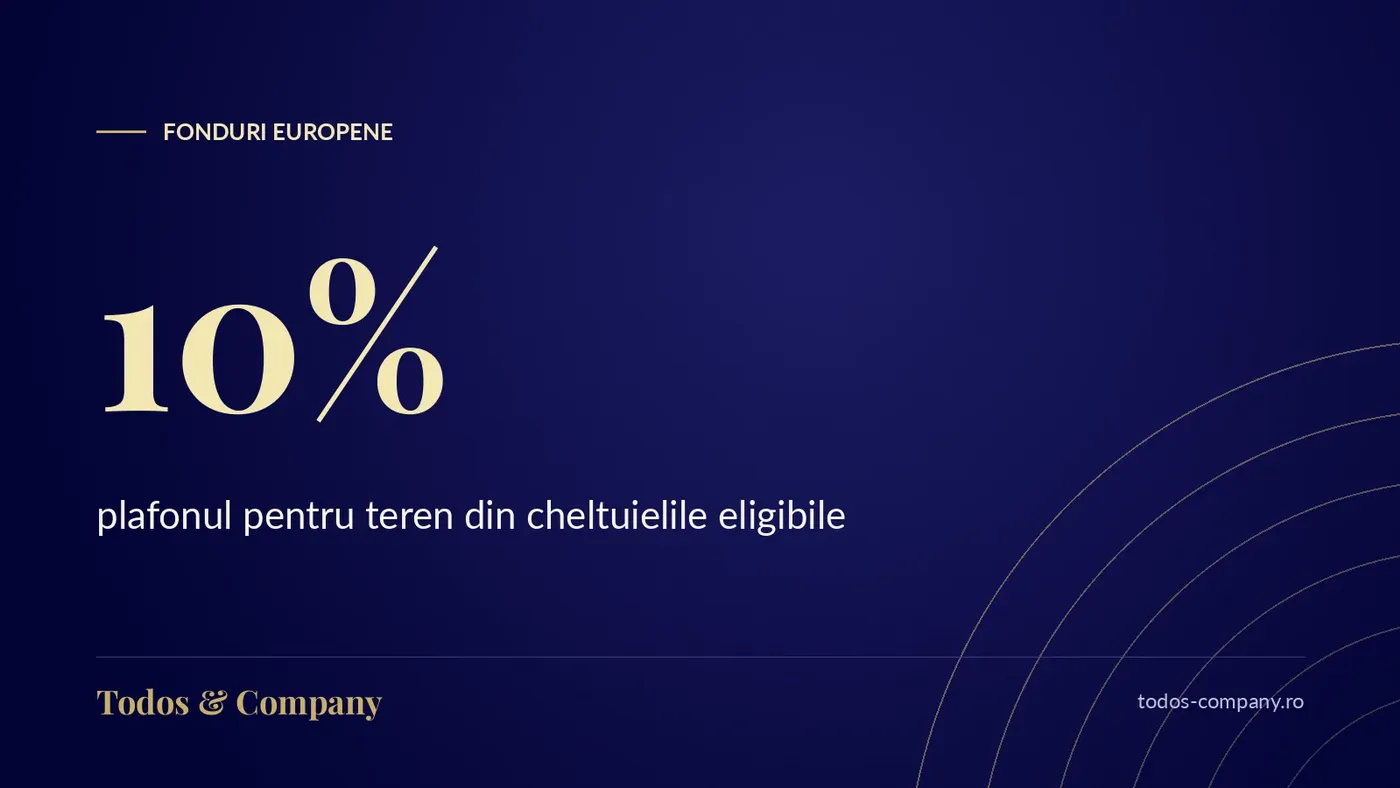
- Land: maximum 10% of the total eligible costs of the operation (15% for abandoned sites and those with former industrial activities that include buildings).
- Indirect costs: flat rate of maximum 7% of eligible direct costs, 15% of direct staff costs or 25% of direct costs, based on a calculation.
- VAT: the threshold of 5,000,000 euro (including VAT) for the total cost of the operation changes the regime.
- Durability: 5 years from the final payment, a period that can be reduced to 3 years for investments and jobs created by SMEs.
What are the general eligibility conditions?
Article 2(1) of HG 873/2022 requires a cost to meet eight conditions cumulatively:
- it must fall within the eligibility period under Article 63 of Regulation (EU) 2021/1060;
- it must be supported by invoices issued in accordance with Law No 227/2015 on the Fiscal Code;
- it must be supported by documents proving that payment was made and that the cost is genuine;
- it must comply with the provisions of the programme;
- it must comply with the funding contract or decision;
- it must be reasonable and necessary for carrying out the operation;
- it must comply with European Union and national legislation;
- it must be recorded in the beneficiary's accounts.
If the operation constitutes state aid, the eligibility conditions of the applicable aid scheme are added (Article 2(2)). For ESF+, the specific provisions of Regulation (EU) 2021/1057 also apply.
The EU regulation also states (Article 63(6)) that operations that have been physically completed or fully implemented before the funding application is submitted cannot be selected, regardless of whether the payments have been made.
Which costs are ineligible?
Article 10 of HG 873/2022, read together with Articles 64 and 66 of Regulation (EU) 2021/1060, mainly excludes:
- interest on loans (except for interest-rate subsidies or guarantee-fee subsidies);
- land above the 10% or 15% ceiling, as applicable;
- second-hand equipment, motor vehicles and means of transport;
- fines, penalties, and legal and arbitration costs;
- relocation costs;
- costs that exceed the ceilings set by the managing authority or that it excludes in the applicant's guide;
- costs excluded by the regulations of each fund (ERDF, ESF+, JTF).
The last points matter a great deal in practice: the applicant's guide can be stricter than the HG. What is eligible in one call may be ineligible in another.
Special rules: land, buildings, vehicles, leasing, VAT
Land and buildings
Example: in a project with total eligible costs of 1,000,000 euro, land can be reimbursed up to 100,000 euro. On a former industrial platform with buildings, the ceiling rises to 150,000 euro. HG 873/2022 also requires the market value to be certified by an independent authorised valuer. Land cannot be financed from ESF+. Buildings that already exist are eligible only if they are strictly necessary for the project and were not bought with public grants in the last 5 years.
Vehicles
Vehicles are eligible only if they are necessary for the operation and have suitable technical characteristics. Their value cannot exceed the ceiling in OG No 80/2001, and for zero-emission vehicles the ceiling is the lei equivalent of 35,000 euro, including VAT (Article 8).
Leasing
Leasing instalments are eligible if the beneficiary is the user of the asset and if they are paid during the implementation period. In addition, the cumulative value of the instalments reimbursed cannot exceed the entry value of the asset in the beneficiary's accounts (Article 7).
VAT
VAT is eligible only if it relates to eligible costs. For operations with a total cost of at least 5,000,000 euro (including VAT), VAT is eligible only if it cannot be recovered under national VAT legislation. The procedure is set out in the Instructions approved by Order No 4.013/5.316/2023. Below the threshold, the beneficiary submits a declaration on VAT eligibility. Above the threshold, it declares that the tax is non-recoverable, depending on its tax status.
Contributions in kind and depreciation
Land, works or voluntary work provided without an invoice may be eligible under Article 67 of the regulation. These include the following: public support does not exceed the total eligible costs excluding the contributions in kind, and the value can be independently assessed. Depreciation is eligible only if the programme allows it and the asset was not bought with public grants.
Simplified costs: indirect and staff costs
Regulation (EU) 2021/1060 allows certain costs to be reimbursed without invoices, on the basis of flat rates:
- Indirect costs (Article 54): maximum 7% of eligible direct costs or maximum 15% of direct staff costs, without the Member State having to carry out a calculation, or maximum 25% of direct costs, with a rate calculated using a fair and verifiable method.
- Staff (Article 55): direct staff costs can be calculated at a maximum of 20% of the other direct costs, if the project does not include public procurement contracts above the European thresholds.
- Remaining costs (Article 56): maximum 40% of eligible direct staff costs.
Worked example: with eligible direct costs of 400,000 lei, the 7% rate allows indirect costs of up to 28,000 lei. If 100,000 lei of that amount is staff costs, the 15% option gives only 15,000 lei at most.
Hourly rate: the latest documented annual gross employment costs are divided by 1,720 hours for a full-time position. An employee with an annual gross cost of 86,000 lei has a rate of 50 lei/hour. The hours declared in a year cannot exceed the number used to calculate the rate.
The guide for each call sets out which option applies. Do not choose a rate on your own that is not provided for there.
What evaluators and verification officers check
Under Article 11 of HG 873/2022, the managing authority checks eligibility at three points: when the application is evaluated, at contracting and at each reimbursement claim. In practice, they look at:
- whether each budget line is linked to an activity and an indicator of the project (the "reasonable and necessary" condition);
- whether prices are supported by quotes or market studies;
- whether the purchase followed the applicable procedure;
- whether the invoice, proof of payment and accounting entry match;
- whether the investment is maintained for 5 years after the final payment (3 years, where applicable, for SMEs) without cessation of activity, relocation outside the NUTS 2 region or substantial changes (Article 65).
What this means for your business
Our recommendation: build the budget starting from the list of eligible costs in the call guide, not from the company's wish list. The mistakes we see most often are:
- second-hand or display equipment included in the budget;
- purchases made before submission, even though the scheme requires that works have not started;
- VAT listed as eligible by a VAT-registered company that can deduct it;
- cash payments or payments from an account other than the one indicated;
- invoices with no reference to the project.
Keep separate accounting records for the project from day one. For an initial check of your fit, you can use the eligibility check.
Frequently asked questions
Can I claim costs incurred before the funding contract is signed?
The regulation accepts costs from 1 January 2021, but the operation cannot be completed before the funding application is submitted. In addition, state aid schemes and guides usually impose stricter conditions on the start of works. Check the eligibility start date in the call guide.
Is VAT eligible for a VAT-registered company?
VAT is eligible only if it relates to eligible costs and has not been, and will not be, recovered through tax mechanisms. For operations of at least 5,000,000 euro, including VAT, you must demonstrate that the tax is non-recoverable under the law. A company that deducts VAT cannot also claim it under the project.
How much of the project can be spent on land?
A maximum of 10% of the operation's total eligible costs, or 15% for abandoned sites and former industrial sites with buildings. The market value must be certified by an authorised independent valuer. The call guide may exclude land entirely.
What happens if I sell the equipment after the project ends?
If, within 5 years of the final payment (or 3 years, where the shorter period for SMEs applies), the activity ceases, relocates outside the region or the project is substantially modified, the support is recovered in proportion to the period of non-compliance.
Official sources
- Government Decision no. 873/2022 on the eligibility of expenditure 2021–2027 (Legislative Portal)
- Regulation (EU) 2021/1060 – common provisions (EUR-Lex)
- Instructions for applying Article 9 of HG 873/2022 on VAT (Order no. 4,013/5,316/2023)
Information checked on 27 September 2026. Conditions may be amended by the managing authority — check the guide in force before submitting.