Co-financing and bridge loans for EU funds: how much you put in, how to prove it, how to manage cash flow
Practical guide: how much the company must contribute from its own sources, how pre-financing of up to 40% with a guarantee works, payment and reimbursement requests, and how to cover cash-flow gaps with a bridge loan.
Todos & Company editorial team · EU funding consultancy since 2006
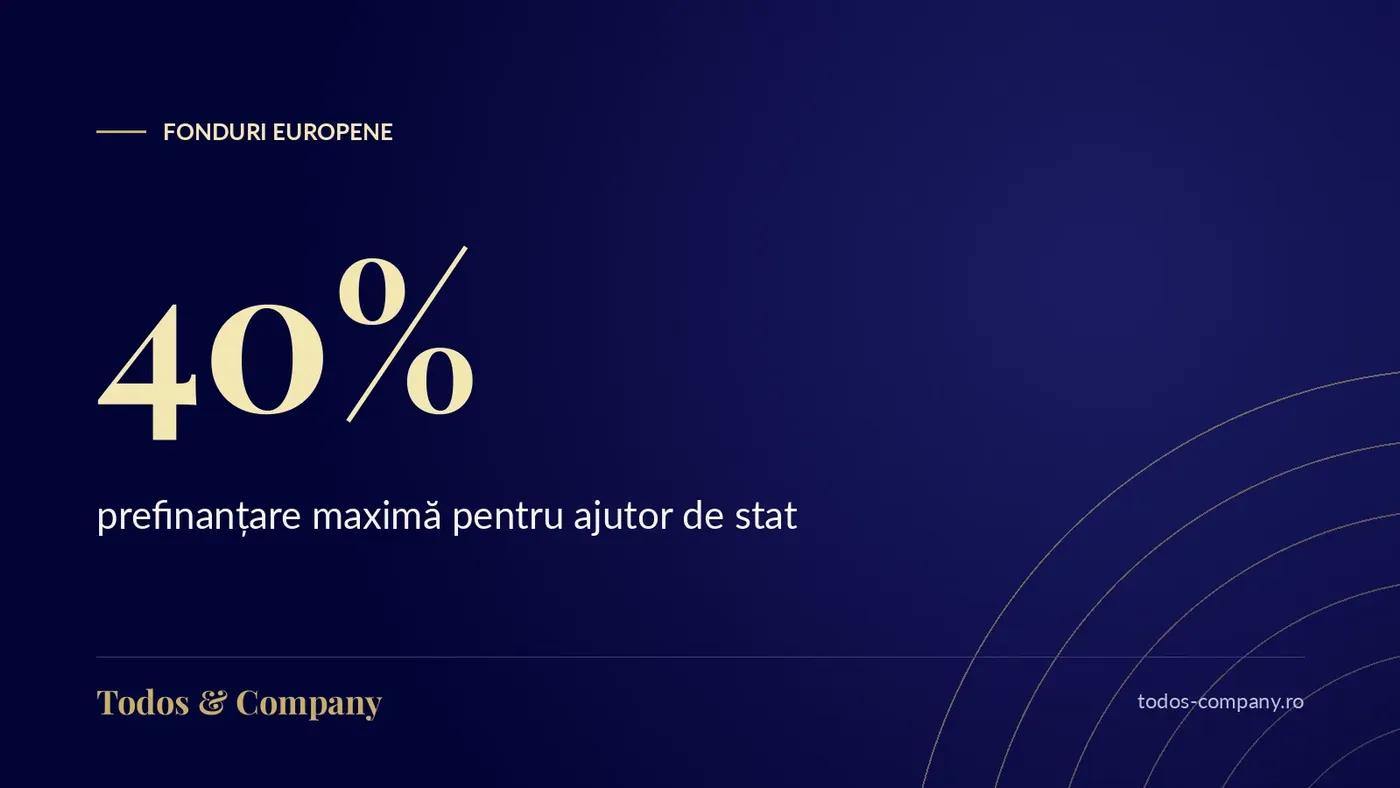
An EU-funded project is not 100% financed by the grant. The company pays its own contribution and the ineligible costs from its own money, and it often receives the grant share only after it has paid its suppliers. For investments with regional state aid, the own contribution is at least 25% of eligible costs. The 2021–2027 programmes allow pre-financing of up to 40% of the aid, but only if the company provides a guarantee. The gap between the time of payment and the time of receipt is usually covered with a bridge loan.
In brief
- Private co-financing: the beneficiary's contribution, other than from public funds (definition in Article 2 of OUG 133/2021).
- Minimum for regional investment aid: at least 25% of eligible costs. The money may come from own resources or external financing, but not from other public aid (Article 14(14) of Regulation (EU) 651/2014).
- Pre-financing for companies receiving state aid or de minimis aid: a maximum of 40% of the total value of the aid, in one or more instalments, provided a guarantee is given (Article 18(2) of OUG 133/2021).
- Justifying the pre-financing: reimbursement requests for at least 50% of the instalment, submitted within a maximum of 90 calendar days of its transfer (Article 18(7)).
- Payment request: after receiving the amount, the beneficiary pays suppliers within a maximum of 5 working days (Article 30(12) of the rules approved by HG 829/2022).
- Core legislation: OUG 133/2021 and HG 829/2022 for the ERDF, the Cohesion Fund, ESF+ and the JTF; AFIR and PNRR have their own rules.
How much must the company contribute from its own money?
The own contribution has three components, which companies often confuse:
- Own contribution to eligible costs. This is the difference between 100% and the aid intensity. The maximum intensity is set by the call guide and, for regional investments, by the regional aid map. Whatever the intensity, the 25% rule in Regulation 651/2014 remains a minimum for regional aid.
- Ineligible costs. These are costs the project needs but the guide does not reimburse. The company pays them in full.
- VAT. Regulation (EU) 2021/1060 (Article 64) declares VAT ineligible, with the exceptions it provides for, including operations with a total cost below €5 million. The call guide says how VAT is treated under the programme concerned. For a VAT-registered company, the tax is in any case a liquidity issue: you pay it to the supplier and recover it later from the state.
Worked example. A project has 1,000,000 lei of eligible costs, the aid intensity is 70% and the ineligible costs are 50,000 lei. The grant is 700,000 lei. The own contribution to eligible costs is 300,000 lei, and the company still has to cover the 50,000 lei of ineligible costs and the VAT on all invoices. In total, the company must finance at least 350,000 lei plus VAT. During implementation it also needs additional liquidity for the share of the grant that arrives after suppliers have been paid.
How do you prove co-financing?
The call guide sets out which documents are required and at which stage (at submission, at contracting or with each payment). There is no single list for all programmes. The sources of funding usually accepted are:
- cash in the company's accounts, proven with a bank statement;
- a bank loan, proven with the loan agreement or with a comfort letter or letter of intent from the bank, as the guide requires;
- contributions from shareholders, for example a loan from shareholders or a capital increase.
One restriction comes directly from Regulation 651/2014: the 25% contribution cannot be covered from other public aid. An ordinary commercial loan is accepted. A subsidised loan, or one guaranteed with public money, must be checked against the cumulation rules in the guide.
Pre-financing, payment requests and reimbursement requests: how the money arrives
OUG 133/2021 offers beneficiaries three settlement mechanisms. Each has a different effect on cash flow.
- Pre-financing. Companies receiving state aid or de minimis aid may request a maximum of 40% of the value of the aid. The guarantee may be issued by a bank, a non-bank financial institution or an insurance company. Within 90 calendar days of the transfer, the company must submit reimbursement requests for at least 50% of the instalment. The pre-financing is recovered from subsequent reimbursements. A new instalment may be requested only after the authority has recovered at least half of the previous one.
- Payment request. The company submits invoices that have not yet been paid, and the authority transfers the grant share. The beneficiary then has a maximum of 5 working days from receipt to pay suppliers, both the grant share and the own contribution, by separate payment orders. If the deadline is not met, the Treasury returns the amount to the managing authority.
- Reimbursement request. The company pays the supplier in full from its own money or from a loan and later recovers the eligible share. For cash flow, this is the most costly option.
Using the figures in the example: for a grant of 700,000 lei, the maximum pre-financing is 280,000 lei. Within the first 90 days, the company must justify at least 140,000 lei through reimbursement requests, meaning it must already have made purchases and payments accordingly.
Bridge loans and guarantees
A bridge loan finances the grant share until it is received and is repaid from the amounts received from the authority. A co-financing loan covers the own contribution and is repaid from the company's activity. Among its objectives, the National Credit Guarantee Fund for SMEs (FNGCIMM) includes facilitating access to EU funds by guaranteeing bridge loans and co-financing loans. The percentage and cost of the guarantee are set for each product, together with the bank.
When assessing a loan, the bank usually looks at the signed funding contract, the schedule of reimbursement requests and the guarantees. The assets acquired in the project are often mortgaged, but the funding contract may restrict their disposal or pledging. Check the clauses before offering them as security.
What this means for your business
Our recommendations, based on the projects we have implemented:
- Prepare the cash budget month by month before submission, not just the project budget. The peak funding need usually arises when large items of equipment are delivered, before the first reimbursement.
- Talk to the bank before submission. A comfort letter is obtained quickly, but actual loan approval can take weeks, and the procurement schedule does not wait.
- Do not underestimate VAT and ineligible costs. They are the most common cause of payment bottlenecks.
- The guarantee for pre-financing has a cost. Compare the guarantee fee with the interest on a bridge loan over the same period.
- Respect the incentive effect. With state aid, do not sign firm orders before the point the guide allows just to secure a good price.
If you do not know which call suits you, start with the eligibility check.
Frequently asked questions
Can I use a bank loan as co-financing?
Yes. Regulation 651/2014 allows the minimum 25% for regional aid to come from own resources or external financing, provided the financing does not include other public aid. The document used to prove the loan (contract, comfort letter) is set by the call guide.
How much can pre-financing be for a private company?
Under programmes managed through OUG 133/2021, companies receiving state aid or de minimis aid may receive a maximum of 40% of the total value of the aid, in one or more instalments, only on the basis of a guarantee issued by a bank, a non-bank financial institution or an insurance company.
What happens if I do not justify the pre-financing on time?
Within 90 calendar days of the transfer of the instalment, the beneficiary is required to submit reimbursement requests for at least 50% of its value. The consequences of non-compliance are set by law and by the funding contract. Plan your purchases so that the threshold is reached.
What is the difference between a payment request and a reimbursement request?
With a payment request, the authority transfers the grant share on the basis of invoices that have not yet been paid, and the company must pay suppliers within a maximum of 5 working days of receipt. With a reimbursement request, the company has already paid in full and later recovers the eligible share.
Do these rules also apply to AFIR or PNRR?
Not automatically. OUG 133/2021 covers the ERDF, the Cohesion Fund, ESF+ and the JTF. AFIR and PNRR projects have their own rules on advances and payments, which you will find in the guide and contract for the programme concerned.
Official sources
- OUG No. 133/2021 on the financial management of EU funds 2021–2027
- Methodological rules for applying OUG 133/2021 (HG No. 829/2022)
- Regulation (EU) No 651/2014 (GBER), Article 14
- Regulation (EU) 2021/1060, Article 64 (VAT)
- FNGCIMM – Guarantees for SMEs
Information checked on 27 September 2026. Conditions may be amended by the managing authority — check the guide in force before submitting.