PEO PRIMII: 7,408 lei per pupil for primary schools at risk of dropout, guide in consultation
The PEO Managing Authority has put the PRIMII programme guide out for consultation until 4 November: 1.21 billion lei for primary schools at risk of dropout, 7,408.19 lei per pupil per school year. 709 schools have submitted applications to the Ministry of Education.
Todos & Company editorial team · EU funding consultancy since 2006
 Programme sheet · Opening soon PEO PRIMII — primary education success: per-pupil grants for schools at risk of dropout
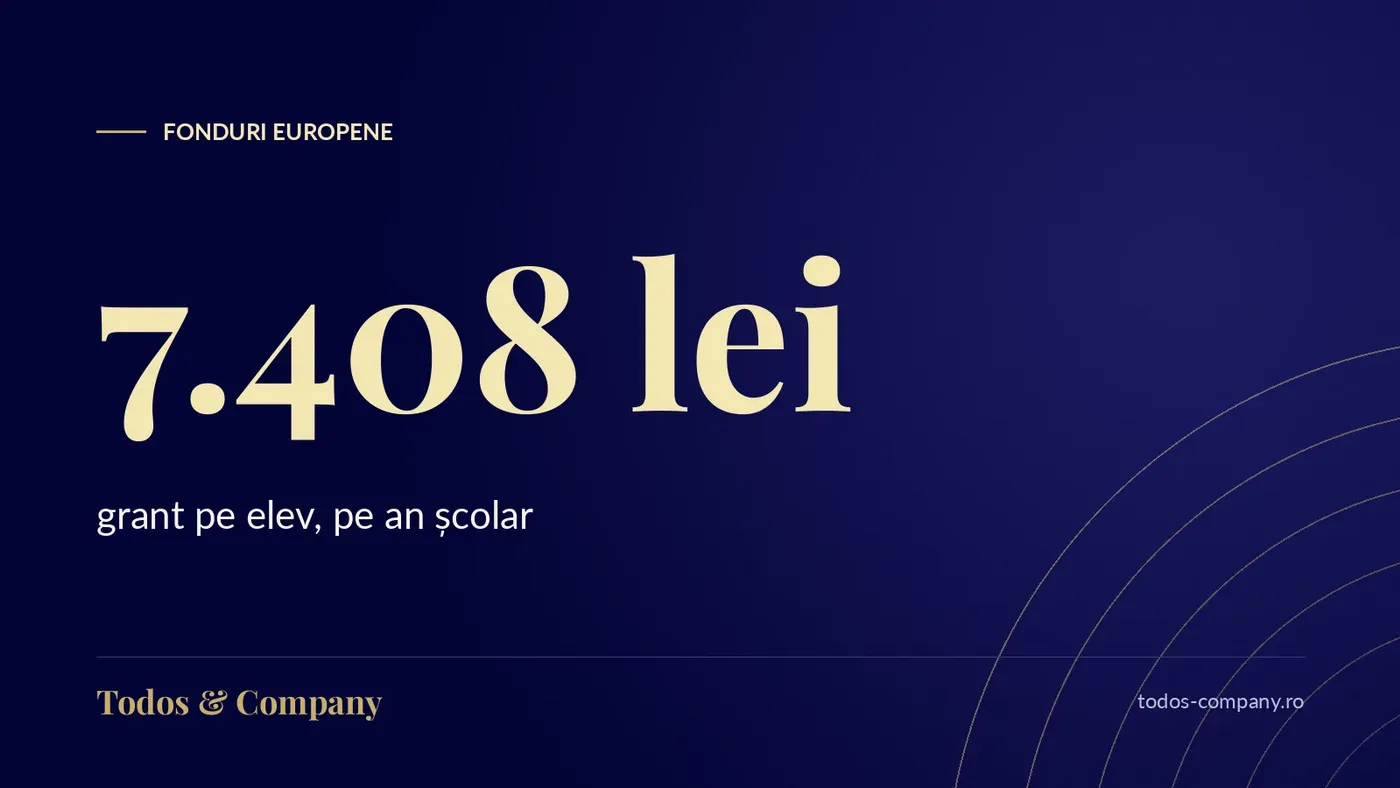
The Managing Authority for the Education and Employment Programme (AM PEO, part of MIPE) published the applicant's guide – specific conditions for "PRIMII: Programme for the Success of Primary Education through Integrated Intervention Measures" for public consultation on 14 October 2026. Comments must be sent by 4 November 2026. The programme is worth more than 1.21 billion lei (approximately 232 million euro) and funds, over three school years, state primary schools at high or very high risk of dropout, at a unit cost of 7,408.19 lei per pupil per school year.
Unlike regular PEO calls, this is a single, non-competitive project, and its beneficiary is the Ministry of Education and Research. Schools do not apply through MySMIS: they were selected through the ministry's own call, which closed on 12 October 2026 and received 709 funding applications.
In brief
- Programme: Education and Employment Programme 2021-2027, Priority 6 (preventing early school leaving), actions 6.f.1 and 6.f.2, ESF+ funding, specific objective ESO4.6.
- Authority: AM PEO (MIPE) for the guide; the Ministry of Education and Research is the sole beneficiary of the project and signs funding agreements with schools.
- Final beneficiaries: state educational institutions with legal personality and a primary level, included on the predefined list (Annex 4) with very high or high risk, with at least 60 pupils in the primary cycle.
- Total budget: more than 1.21 billion lei, for approximately 50,000 pupils in the primary cycle; at least 350 schools to be contracted.
- Value per school: number of primary pupils × 7,408.19 lei (1,408.83 euro) × three school years (2026-2027, 2027-2028, 2028-2029).
- Implementation period: 25 September 2026 – 31 December 2029.
- Status: the PEO guide is in consultation until 4 November 2026; the call for schools closed on 12 October 2026, the evaluation was scheduled to finish on 20 October, and the final list is approved by ministerial order.
What is PRIMII and who receives the money?
PRIMII continues the logic of the National Programme for Reducing School Dropout (PNRAS), but moves the intervention down to the primary cycle. The list of eligible schools was set by the ministry on the basis of the Early Warning Mechanism in Education (MATE) and the community marginalisation index developed with UNICEF, not through an open competition.
To be eligible, a school must meet three cumulative conditions: be on the predefined list with very high or high risk, have at least 60 pupils enrolled in the primary cycle (including affiliated structures), and apply the MATE form for primary education, with the SIIIR module, by 30 October at the latest. A declaration that the same activities are not funded from other public funds is also required.
The application was submitted by the unit with legal personality, by e-mail, by 12 October 2026, 17:00. The application is signed by the head teacher and accompanied by the decision of the board of directors; the official documents do not provide for any role for the town hall in submitting or endorsing it.
How much does a school receive and what can it spend it on?
The grant is calculated mechanically: the number of pupils in the primary cycle multiplied by the unit cost of 7,408.19 lei per pupil per school year, for three school years. A detailed budget is not required at submission, and reimbursement is made on the basis of validated pupils, not invoices. The ministry describes the amount as "almost a doubling of the standard funding" received by a pupil in these schools.
The expenditure categories set by the ministry are:
- salaries for staff involved in activities with pupils (hourly pay);
- trips and camps;
- goods and services for pupils (teaching materials, educational resources);
- food for participation in project activities, calculated in the unit cost using a benchmark of 16.50 lei per day per pupil (the value in HG no. 1,171/2025) for 175 days per school year; the benchmark is not mandatory, and the school sets the number of days and pupils according to participation;
- administrative costs of the unit, through a flat rate of 15% of direct staff costs, from which the grant management team (including the head teacher, if they are the coordinator) and administrative staff are paid.
There are no mandatory percentages per category. The only firm obligation is that every pupil claimed must take part in "After-School" type activities, with a preventive role. Individualised lessons and catch-up activities, extracurricular activities, school counselling and parental counselling are added to these.
How are applications scored?
The methodology approved by Order no. 5,798/13.10.2026 awards a maximum of 100 points: 40 points for very high risk of early school leaving or 30 for high risk; 30, 20 or 0 points according to the community's degree of marginalisation; 30 points for rural areas, 20 for small urban and 10 for large urban. The timetable provided for clarifications until 14 October, answers until 16 October and completion of the evaluation on 20 October, followed by two days for appeals. The final list is approved by order of the minister and published on edu.ro, and the approved application becomes Annex 1 to the funding agreement.
What is the role of the PEO guide put out for consultation?
The AM PEO guide sets the framework under which the Ministry of Education submits and implements the non-competitive project from which school grants are paid: eligibility conditions, activities, indicators and reimbursement rules at programme level. Comments should be sent to consultare.peo@mfe.gov.ro by 4 November 2026. Until the final guide is approved, details in the consultation version may change.
What this means for your business
For consultants and for town halls with schools on the list, our recommendations are as follows:
- If the school has applied, prepare your management team, staff selection procedures and "After-School" planning now, because according to the ministry's FAQ, activities with pupils must begin by 30 October at the latest.
- If the school has not applied, the official FAQ says further rounds will be launched "at the beginning of the next school year, only within the available budget". No date has been announced. You can already prepare the MATE application and check the 60-pupil threshold.
- Common pitfall: reimbursement on a unit-cost basis does not mean there are no records to keep. Pupil attendance is reported by name from SIIIR, with standardised labels per activity, and for the head teacher's remuneration the ministry recommends that documents also be endorsed by another person, to avoid a conflict of interest.
- For local authorities (UAT), cash flow between reimbursements must be planned in advance together with the school, because settlement is made per pupil, after the end of the school year, not on invoices.
If you manage several programmes for schools or town halls, you can use the eligibility check to quickly see which other funding options suit you.
Frequently asked questions
Can schools still apply for PRIMII?
Not in this round. The deadline was 12 October 2026, 17:00, and the ministry announced 709 applications submitted. According to the official FAQ, further rounds will be launched at the beginning of the next school year, only within the remaining available budget.
How much exactly does a school with 100 primary pupils receive?
The grant is calculated as 100 pupils × 7,408.19 lei × 3 school years, i.e. approximately 2.22 million lei over the whole period, provided that pupils are validated annually and take part in "After-School" type activities.
Does the money have to go through the town hall?
The funding agreement is signed between the Ministry of Education and the school with legal personality, and the application is submitted by the school, signed by the head teacher, together with the decision of the board of directors. The official documents published do not provide for any role for the town hall in submitting or endorsing the application, and do not detail its involvement in budget execution.
What happens to the PEO guide after 4 November?
AM PEO reviews the comments received and publishes the final guide. Until then, the conditions in the consultation version may change. Grants to schools are carried out on the basis of the ministerial order and the funding agreements, within the ministry's non-competitive project.
Can the head teacher and the project team be paid?
Yes. The ministry states in the FAQ that the management team is remunerated in accordance with the legislation on salaries for staff paid from public funds, and that its costs are covered from the 15% flat rate, not from hourly pay for activities with pupils. The head teacher may be the project coordinator, with the recommendation that documents concerning their own remuneration also be endorsed by another person, to avoid a conflict of interest.
Official sources
- AM PEO – applicant's guide with specific PRIMII conditions, in public consultation (14 October 2026)
- MIPE – announcement of the PRIMII public consultation, deadline 4 November 2026
- Ministry of Education and Research – PRIMII programme page
- PRIMII selection call announcement (28 September 2026)
- Evaluation and selection methodology, annex to Order no. 5.798/13.10.2026
- PRIMII questions and answers (7 October 2026)
- MEC press release – launch of PRIMII (28 September 2026)
- MEC press release – 709 funding applications submitted (14 October 2026)
Information checked on 19 October 2026. Conditions may be changed by the managing authority — check the guide in force before you submit.